
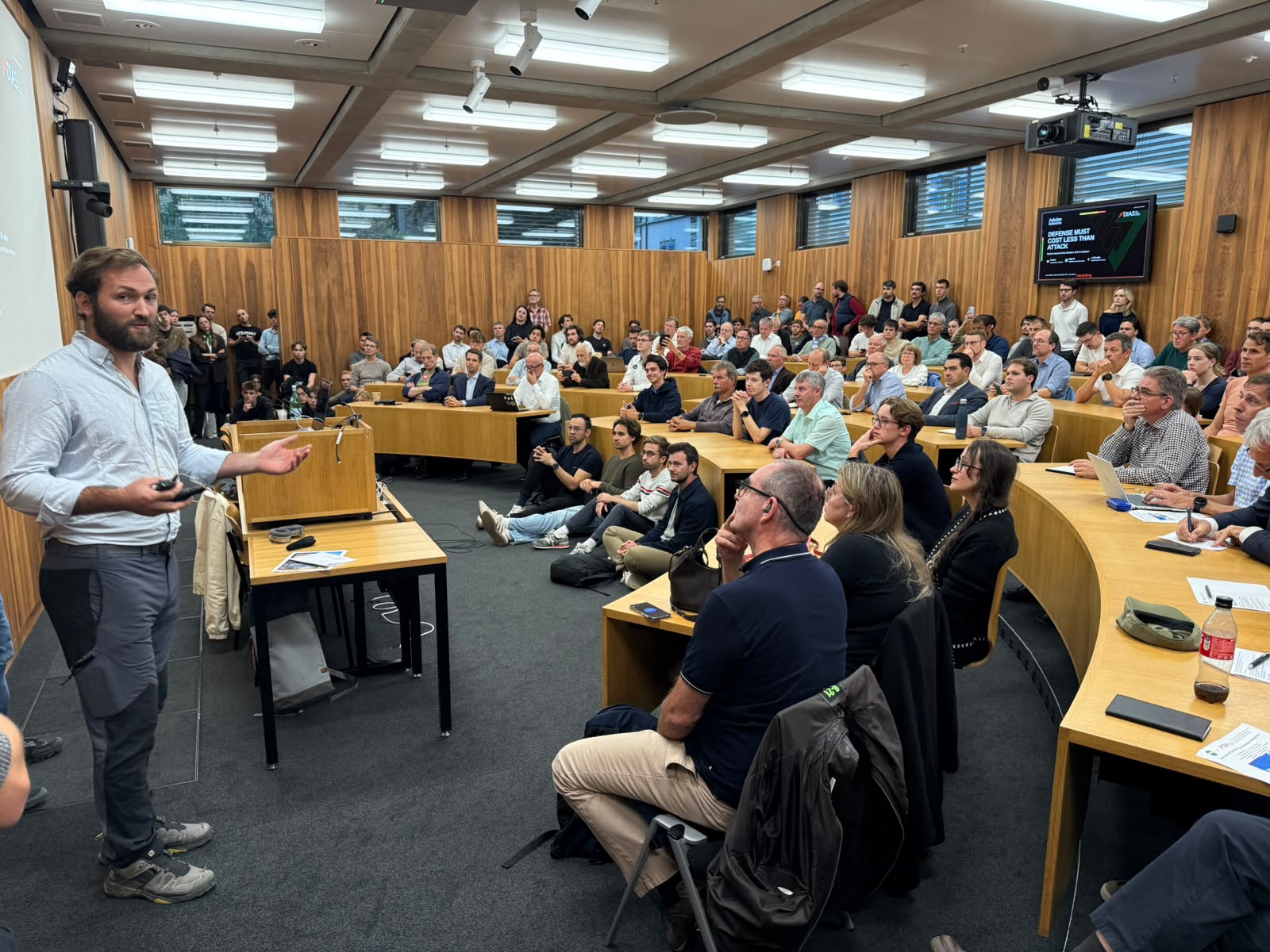
A packed room, thought-provoking presentations and lively discussions: last night’s counter-drone event at ETH Zurich was a tremendous success. With every seat taken and standing room only, the turnout demonstrated the strong interest in a pressing question: how can we protect society against drone threats while enabling the benefits of legitimate drone operations?
Our five speakers brought perspectives from research, industry, civil aviation and defence. Together, they highlighted a challenge that reaches far beyond technology, touching on coordination, procurement, funding and the pace at which Switzerland can respond.
An accessible technology—and an evolving threat
Professor Roland Siegwart of ETH Zurich set the scene: low-cost components and widely available open-source designs mean that almost anyone can build a drone, including those who intend to use it as a weapon.
Research is advancing across the counter-drone process, from searching, tracking and classifying to identifying and intercepting. Roland also highlighted research into how 4G and 5G communications networks could help monitor drone operations, opening another avenue for understanding what is happening in our skies.
Detection requires more than one approach
Louis Saillans, Defence Specialist and CEO of Askalon Industries, explored the strengths and limitations of drone detection technologies. Radio-frequency sensing, radar, optical systems and acoustics all have a role, with trade-offs involving cost, power consumption, weather and line of sight.
Acoustic detection offers particular advantages: it is passive, requires little power and can detect sound around obstacles. The growing use of drones to smuggle goods into prisons illustrates the practical need for effective protection today.
Switzerland has many critical sites that could benefit from counter-drone systems. But an essential question remains: who will pay?
Speed changes everything
For Alexander Ens, Founder and CEO of ENS Dynamics, the challenge is increasingly about speed and economics. Drones are small, agile, inexpensive and getting faster—so fast that, as he put it, “attack drones are becoming missiles”.
Faster targets leave less time to respond. Counter-drone systems must keep pace, combining rapid responses with human oversight—the “human on the loop at machine speed” approach.
Affordability matters too. Defences need to make economic sense against the threats they address. Alexander also emphasised the value of operational feedback and letting users choose technologies that prove effective in practice.
Knowing what is in our airspace
Larissa Haas, Head of the Technology and Innovation Section at the Federal Office of Civil Aviation, highlighted the importance of distinguishing negligent drone operations from deliberate attacks.
Her message was that clear responsibilities must be matched by the means to act. Electronic conspicuity—making legitimate aircraft and drones electronically visible and identifiable—could support a clearer picture of airspace activity.
Achieving that picture requires coordination between the Swiss Armed Forces, cantonal police and operators of critical sites, alongside the integration of legitimate drone operations.
A response that can evolve with the threat
Kai Holtmann, MD Drone Task Force at armasuisse, underlined a lesson from modern warfare: mass matters. Large numbers of inexpensive drones can threaten critical infrastructure and place considerable pressure on defences.
This is a shared civil and military challenge, and its rapid evolution demands faster approaches to procurement and deployment. Kai highlighted the importance of Swiss capabilities, the constraints facing industry and the developing civil-military Center for Uncrewed Systems. He also welcomed ideas and proposals at zeus@vtg.admin.ch.
Who funds a safer sky?
Simon Johnson, Secretary General of DIAS, posed an important question: should counter-drone infrastructure be treated as a public service, supported initially by public funding?
Protecting individual sites is part of the picture. Building a coordinated capability that serves wider society raises broader questions about investment, responsibility and shared benefit.
Text by DIAS
AAZ would like to wholeheartedly thank DIAS and every speaker personally: Simon Johnson, Roland Siegwart, Louis Saillans, Alexander Ens, Larissa Haas and Kai Holtmann